
Nine times out of ten, when someone comes to me wanting composite boards, they’ve already done their homework. They know they don’t want to oil a deck every eighteen months. They’ve seen a neighbour’s Trex or ModWood deck and liked what they saw. They’ve made up their mind on the surface.
Then we ask what’s currently underneath, and that’s where the conversation changes.
A rotting or termite-damaged pine frame with quality composite boards on top is still a failing deck. It’ll flex. It’ll drop in places. The boards will last thirty years. The frame definitely won’t. We’ve had clients come back to us after getting a cheaper job done somewhere else, four or five years later, boards still looking decent but the whole structure moving underfoot. It’s a frustrating outcome, especially when fixing it properly means pulling everything apart anyway.
What Composite Boards Actually Are
Wood fibre or bamboo combined with recycled plastic polymers, extruded into board profiles that pass for timber. That’s the basics. The plastic component is what keeps them from rotting, splintering, or reacting badly to moisture. UV stabilisers in the better products (Trex, ModWood, Futurewood) keep the colour from washing out significantly, and most of them are backed by 25-year structural warranties.
They don’t need oiling. Don’t need staining. Salt air from the Northern Beaches, UV from a north-facing aspect in Penrith, the temperature swings you get in the Hills District. Composite boards handle all of that better than raw or oiled timber.
What they can’t do is hold up a structure. That’s the frame’s job.
Why We Pair Them With Steel
A good composite board is built to last 25 to 30 years. If the frame underneath it gives out at year twelve, you’ve wasted the board. Galvanised steel framing is designed to go at least as long as the boards, usually longer. You’re not setting up a situation where the expensive surface outlives the cheap structure underneath it.
Steel doesn’t move seasonally the way timber does. That matters more than people think. Composite boards expand and contract slightly with temperature, and manufacturers design their fastening systems around that movement, and they need a stable base for those systems to work properly. A timber frame that’s drying out and shifting seasonally doesn’t give them that. You end up with gaps that aren’t even, fasteners that work loose, boards that lift slightly at the ends. On a steel frame, what was flat and square when we built it stays that way.
Termites can’t damage steel. They might still trail across it looking for a path to something else, but they can’t touch the structure itself. On a timber frame, by the time you see the trails, the damage is often already done.
The Bushfire Side of It
In BAL-29 and above (and there’s a lot of Sydney that sits at BAL-29 or above), you need non-combustible structural framing by law. Steel qualifies. Many of the major composite board brands carry BAL certification at BAL-29 and BAL-40 too, so the whole deck can be compliant from frame to surface.
If you’re in Dural, Berowra, Castle Hill, Kenthurst, anywhere along the lower Blue Mountains, the chances are your block has a BAL rating that already requires this combination. Getting both the frame spec and the board spec right before we start means council approval goes through cleanly. Finding out after the fact that your boards aren’t BAL-rated for your zone is a much worse conversation to have.
At BAL-FZ, the highest rating, composite wood-plastic boards generally won’t make the cut. That’s fibre cement board territory. But for most residential jobs in the BAL-29 to BAL-40 range, quality composite on steel is the right answer.
What It Looks Like
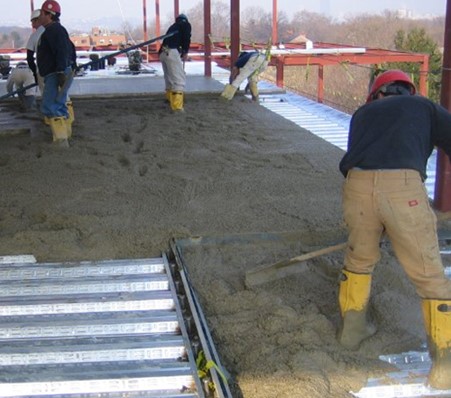
Better than it used to, honestly. Early composite boards were easy to spot: slight sheen, plastic-looking grain, a consistency that didn’t quite read as timber. The current generation is genuinely different. ModWood and Trex especially have profiles and colour variation that sit well alongside real wood and stone. We’ve installed them on contemporary homes in the Hills District and heritage-adjacent terraces in the inner suburbs and they’ve worked in both contexts.
Colours run from warm tawny browns through to charcoal greys. Coastal properties tend to go for the lighter tones with grey or blue-grey undertones. They handle salt air without the surface cracking you’d get with unprotected spotted gum, and they sit naturally against rendered or weatherboard exteriors.
The structural side of steel also opens up designs you can’t pull off with timber. Longer spans, fewer posts, cleaner sight lines underneath. Split levels are easier. Unusual shapes are more achievable. It’s not just a maintenance upgrade. It often ends up being a design upgrade too.
The Running Cost
Proper timber deck maintenance in Sydney is oiling or staining every one to two years. A mid-sized deck: most of a weekend, several hundred dollars in product, every cycle for the life of the deck. Over fifteen years that’s a lot of time and money spent on a surface that still needs replacing eventually.
Composite on steel: hose it down a couple of times a year. That’s about it.
For anyone who’s spent a long weekend on their knees restaining a deck that looked good for six months before the sun got to it, that’s not a small thing.
To talk through options for your site, take a look at our composite decking installation in Sydney page and get in touch.



