
If your property carries a Bushfire Attack Level rating, you need a builder who actually knows what that means. We build fire-resistant, code-compliant decks for homeowners across Sydney, the Blue Mountains, the Hills District, Sutherland Shire and surrounding bushfire-prone areas. All work meets AS 3959.
We’ll call or email the same day. No spam, ever.
If your property carries a BAL rating, you can’t just pick a material you like and start building. A deck that doesn’t meet the requirements for your rating isn’t just a fire hazard. It can fail council approval, breach AS 3959, and leave you with a structure you’re legally not allowed to use.
The problem is that most decking companies don’t regularly work in bushfire-prone zones. They’re not across the BAL rating system, they’re not sure which products and methods are required for each level, and they’re not going to help you navigate what your council actually needs.
We are. This work makes up a significant part of what we do, across some of the most fire-prone areas in greater Sydney.
Before any work starts, we assess your property's Bushfire Attack Level. Ratings run from BAL-LOW at the low end through BAL-12.5, BAL-19, BAL-29, BAL-40 and up to BAL-FZ (Flame Zone), the most severe classification, meaning the site faces potential direct flame contact.
Here's what changes at each level, in practical terms:
Standard hardwood, composite, and treated pine can all be used, though anything within 300mm of a window under 400mm above deck level needs a bushfire-resistant timber species even at BAL-12.5.
Boards, supports, framework and stair treads all need to be non-combustible or a genuinely bushfire-resistant hardwood. Subfloor supports need to be non-combustible or bushfire-resistant timber if the subfloor is left open. Your main options here are:
Standard timber decking is off the table entirely. No gaps where embers could lodge. Your realistic options are:
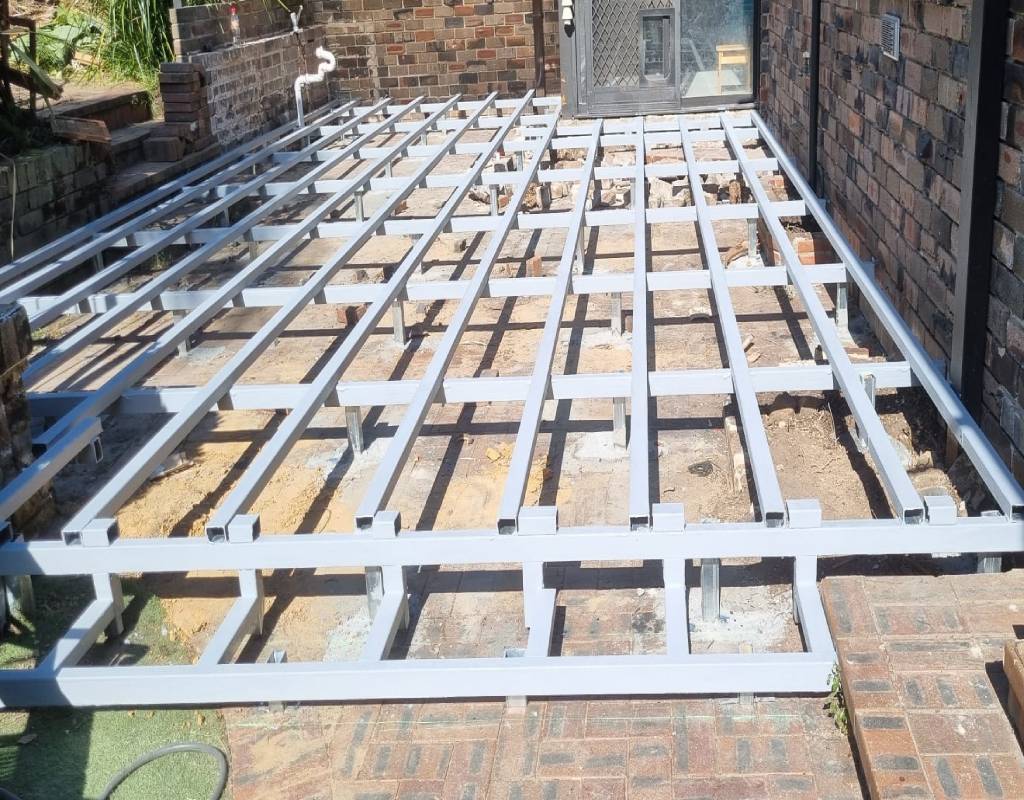
We default to galvanised steel framing (Boxspan is our usual choice) for exactly this reason: it won’t rot, won’t attract termites, and meets every BAL requirement including Flame Zone.
The most restrictive classification. Every element, boards, frame, fixings, balustrades, has to be non-combustible. Realistic options at this level are:
Any gap over 3mm needs corrosion-resistant steel mesh with apertures under 2mm, and structural supports need a Fire Resistance Level of at least 30/30/30.
We’ll confirm what your specific rating requires before quoting, so there are no surprises at the council stage.
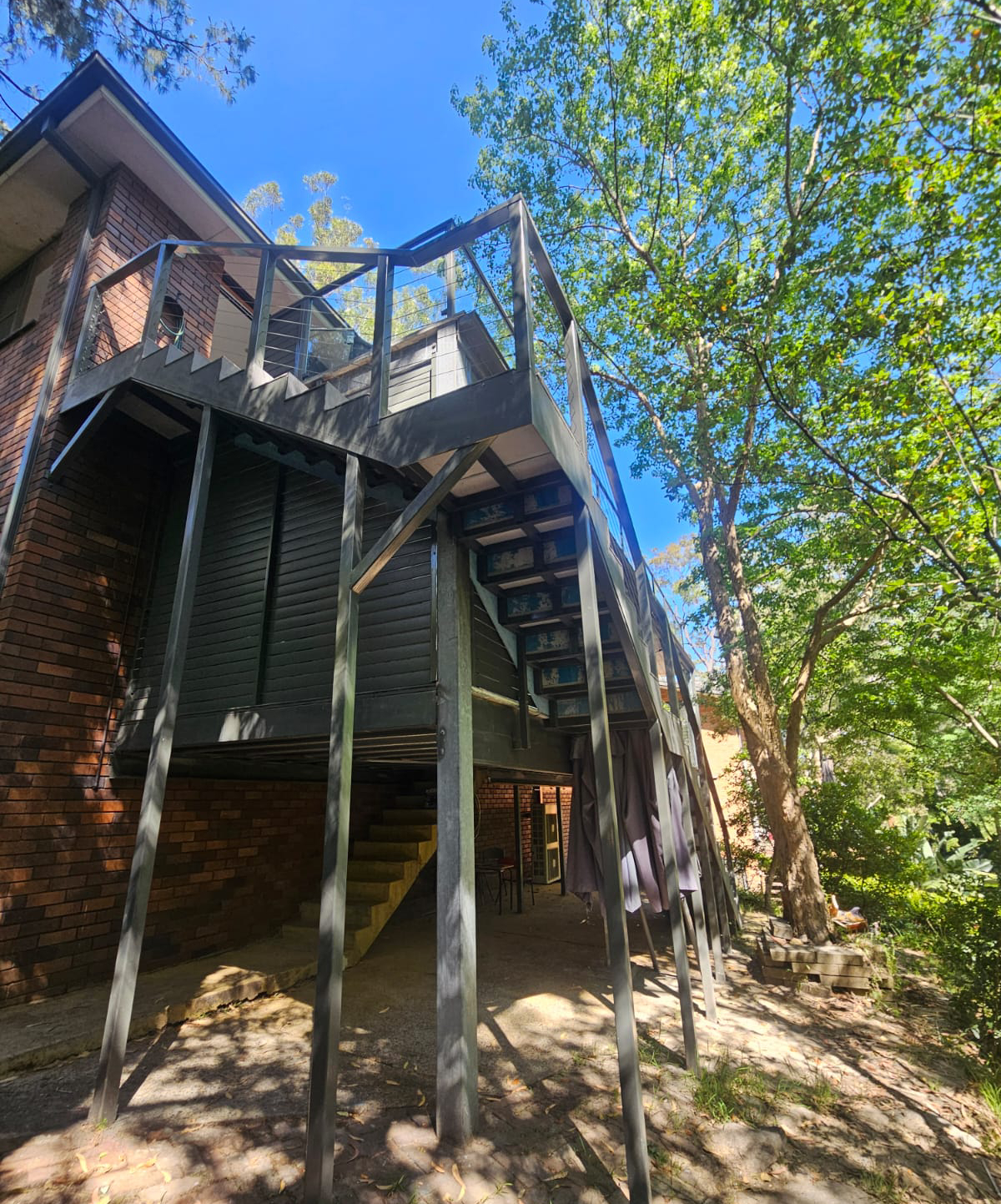
Most people focus on what they can see and touch, the decking surface, and assume that’s where the fire safety lives. It isn’t.
We had a client call last year, a property in the lower Blue Mountains, BAL-40 rated. He’d already picked out his composite boards, done the research, knew they were fire-resistant, felt sorted. He wanted a quote to put them over his existing pine frame. We had to explain that the boards were the least of his problems.
Under AS 3959, from BAL-29 onwards, the structural frame of a deck has to be non-combustible. Treated timber, regardless of how it’s been treated, doesn’t make that cut. Ember attack is responsible for a large share of residential losses in major fire events, with embers travelling well ahead of the fire front, landing under decks, and finding dry, enclosed timber to work with. A steel frame gives embers nothing to catch on. They land, there’s no fuel, the sequence that would otherwise start under your deck and work its way into your fascias and windows never gets going.
It’s why we won’t frame a deck in timber in a BAL-29 zone or higher. Not because the rules say not to. Because the rules are right.
We've built across some of Sydney's most fire-prone areas: the Blue Mountains, the Hills District, Hornsby Shire, Ku-ring-gai, and the Northern Beaches. AS 3959-2009 is something we work to every week. You don't have to figure out what your council requires. We already know.
Not every product marketed as fire-resistant is approved for every BAL rating. We specify materials that are genuinely compliant for your property's exact classification: steel framing, fibre cement and cement board options such as HardieDeck, fire-rated composite boards, and properly installed ember guard systems.
A lot of bushfire-prone properties sit on sloping blocks, elevated ground, or scrubby terrain that general builders shy away from. We're experienced with difficult sites. If the block is tricky, that's not a problem for us. It's a normal part of the work we do.
We're a small, owner-operated team. Serg oversees every project personally from quote to completion. You'll deal with the same person throughout, and you'll get straight answers about what your site needs and what it will cost.
A large part of our work sits in areas where bushfire risk is genuinely real, and where Serg and the team have built at BAL-29 and above personally, not just quoted on paper:
Not sure if your property has a BAL rating? Most councils in these areas require BAL compliance for any new deck or major renovation within a mapped bushfire-prone area. We can advise. It’s worth knowing before you build.
A steep hillside property in Belrose, backing straight onto Ku-ring-gai Chase National Park bushland. The homeowner wanted a traditional, sprawling timber deck with wide board gaps for a rustic entertaining space. The BAL assessment came back at BAL-40, driven by the steep slope (which accelerates fire run-up) and the heavy canopy proximity.
Council knocked back the first Complying Development Certificate application. The problem was the proposed subfloor, partially open on a steep decline, which created what the assessor called an ember trap underneath the structure.
Rather than get stuck in redesign after redesign, we rebuilt the specification from the ground up: a fully non-combustible, hot-dipped galvanised steel post and Boxspan joist frame; the entire perimeter subfloor enclosed down to the rock line with fire-rated screening and stainless steel ember mesh under 2mm apertures; and HardieDeck fibre cement boards with zero open gaps in place of the timber the client originally wanted.
Council signed off on the resubmission without needing a bushfire consultant panel review. Designing to the actual code from the start, rather than hoping a workaround gets through, is what saved this client months of delay.
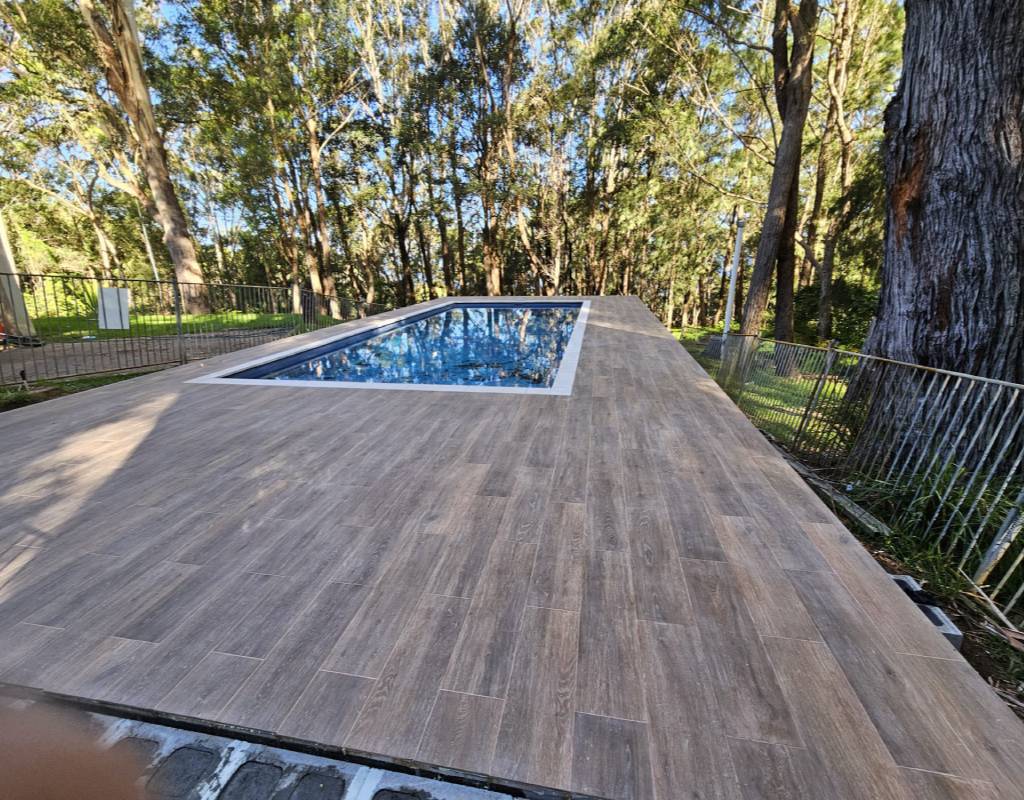
A BAL-29 rated property backing onto bushland in Hornsby Shire. We installed a light gauge galvanised steel subframe with composite decking boards, ember guards along all perimeter edges, and a compliant subfloor enclosure. The homeowner wanted something that looked great and passed council. Both outcomes achieved.
An elevated deck on a sloping block near Katoomba, rated BAL-40. Non-combustible framing was mandatory at this rating. We used light gauge galvanised steel framing throughout with a HardieDeck fibre cement board (a cement board decking finish), which carries the required fire resistance classifications. Clean, modern result on a challenging site.
We were called out to inspect a rebuild in Kenthurst, a BAL-29/BAL-40 zone, after a general landscaping handyman had built the client a large timber deck off their living room slider two years earlier.
The frame was standard treated pine (H3 grade) under Merbau boards, with the entire subfloor left open. The boards themselves were spaced at 8mm gaps, wide enough for embers to lodge freely. When a spot fire blew embers through the area one dry summer, leaf litter and bark that had built up in the open subfloor cavity caught alight underneath the deck. The fire tracked down the treated pine joists and reached the sliding door frame, filling the home with smoke before it was brought under control.
When the homeowner lodged an insurance claim, the insurer’s own audit found the deck had been built without a Complying Development Certificate and didn’t meet AS 3959. The claim for the structural repairs was refused.
It’s the clearest illustration we’ve seen of what a BAL rating is actually protecting against. It was never really about whether the top board burns. It’s about eliminating ember traps, using a non-combustible frame, and keeping mesh under 2mm so windblown coals can’t start a fire under your living room in the first place.
Whether you’re building a new deck or replacing one that no longer meets current standards, we’ll come out, confirm what your BAL rating requires, and give you a straight quote. No runaround, no vague estimates.




We’ll call within 24 hours. No spam, ever.
