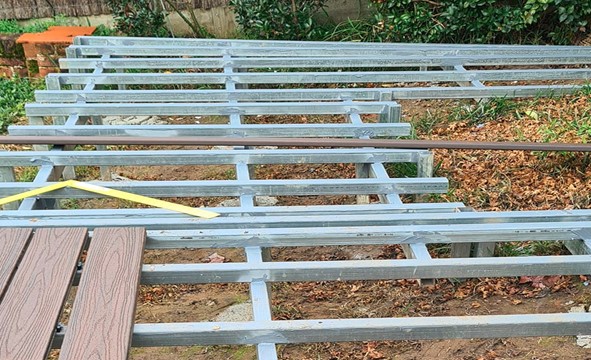
Here’s something we see constantly. A homeowner has a deck they’re sick of. Boards are tired, maybe a bit rough, and they want it done properly this time. We pull everything apart to start fresh, and the first thing we find is a frame that should have been replaced years ago. Rotted posts, joists that flex more than they should, a bearer that’s dropped enough to create a visible dip in the surface.
Meanwhile the boards that came off aren’t even that bad. A few more years of life in them, maybe. But they’ve been sitting on a frame that was quietly failing, and nobody knew because nobody was looking at the frame. We ran into exactly this on a St Ives retrofit, a good looking Spotted Gum deck sitting on a treated pine frame that had quietly rotted underneath.
This is the most common thing we deal with. And it’s almost always treated pine underneath.
The Actual Lifespan of a Pine Frame in Sydney
H3 or H4 treated pine has reasonable pest and rot resistance when it goes in. Fresh from the yard, it’s decent material. But that chemical protection doesn’t last indefinitely, and Sydney doesn’t give it an easy run.
The humidity alone takes a toll. Coastal areas (Northern Beaches, Sutherland, eastern suburbs) add salt air into the mix, and that accelerates degradation in the timber and in the hardware and fasteners connecting everything. Out west in Penrith, Parramatta, the Hills District, you’ve got a different problem: bigger temperature swings, heavy summer rain events, long dry stretches that make the timber contract and move.
Most pine frames we see that are fifteen years old are showing real problems. Not all of them, but most. A post that’s soft at the base, a joist that bounces underfoot, a section that’s visibly low because the bearer underneath has given. Sometimes it’s worse. Sometimes there’s termite activity that’s been working through the structure for years without anyone noticing because you can’t see it from above.
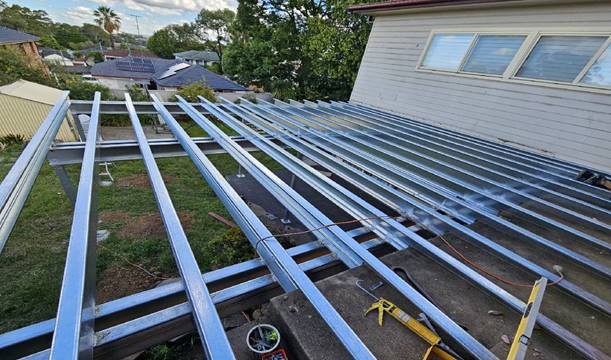
Galvanised steel doesn’t do any of that. It doesn’t absorb moisture, doesn’t move with the seasons, doesn’t feed anything. A properly specified steel frame is realistically looking at thirty-plus years in residential conditions. In coastal areas you need to think more carefully about the corrosion protection spec, but the service life expectation is still well ahead of treated pine in the same environment. Here’s what that actually looks like on a job near the water.
How the Installation Actually Goes
One thing worth knowing about steel frame installation: most of the precision work happens before we arrive on site.
With timber, a lot of the fit-out is done in the field. Framing gets cut and adjusted to suit what’s actually there, which is fine, but it means you’re working with material that has natural variation: twist, bow, moisture differences between lengths. Getting it level and square takes time, and some of what’s done on site is corrective.
Steel sections come pre-manufactured. Cut to length, pre-drilled. When they land on site, they go together the way they were designed to go together. The frame is genuinely flat and square when it’s done, not approximately flat after some creative shimming.
That matters for what goes on top. Composite boards, hardwood, fibre cement. They all sit better on a steel frame. Gaps are consistent, fasteners engage properly, the surface looks the way it was designed to look. And five years later, it still looks that way, because the frame hasn’t moved.
Fewer Posts, Better End Result
Steel spans further than timber at the same section depth. For a deck that needs to cover a slope, clear a retaining wall, or just look clean without a forest of posts underneath, that’s a real difference.
Timber framing hits span limits that force intermediate posts and beams you wouldn’t otherwise want. More posts means more footings, more connection points, more places for moisture to collect and things to go wrong. It also affects how the space underneath the deck can be used, and what the deck looks like from the garden.
Steel doesn’t have those limitations to the same degree. Longer clear spans are straightforward. On contemporary builds in the Hills District, Northern Beaches, and North Shore where clean lines are part of what the architect or client is going for, steel framing is often the only way to achieve the design properly.
The Council Side of It
Sydney councils aren’t uniform. Bushfire overlays, heritage controls, local planning instruments. Depending on where you’re building, any of these can add requirements that change what’s possible and what needs to be documented.
For anything in a BAL-29 or higher zone, which covers significant parts of the outer suburbs, the NCC requires non-combustible structural framing. Steel is the answer. Specifying it from the start means no last-minute material changes, no re-quoting, no conversations with the certifier about alternative solutions.
Steel framing also tends to get through the inspection process without drama. The material is manufactured to known specifications, the structural certification is available, and the inspector can see exactly what they’re looking at. No ambiguity about treatment levels or material grade, which can come up with site-cut timber.
What You’re Actually Paying For
A deck that’s properly built on steel, with boards that suit the site, should still be performing well in thirty years. Not just standing. Actually performing. Still level, still sound, without the maintenance cycle that a timber frame demands.
That’s what good deck installation services in Sydney should be delivering. Not the cheapest job today, but the right job for the life of the structure.
To talk through what that looks like for your project, visit our page on expert deck installation services in Sydney using steel frame decking systems and get in touch.



