Most decking advice on sloped blocks focuses on the wrong problem. It talks about design, cantilevers, split levels, without ever addressing why the subframe underneath so often fails first on a real Sydney hill. We’ve built enough of these to know the slope itself is what breaks a timber frame, and it’s also exactly why steel earns its keep here more than almost anywhere else.
What actually goes wrong with timber on a steep block
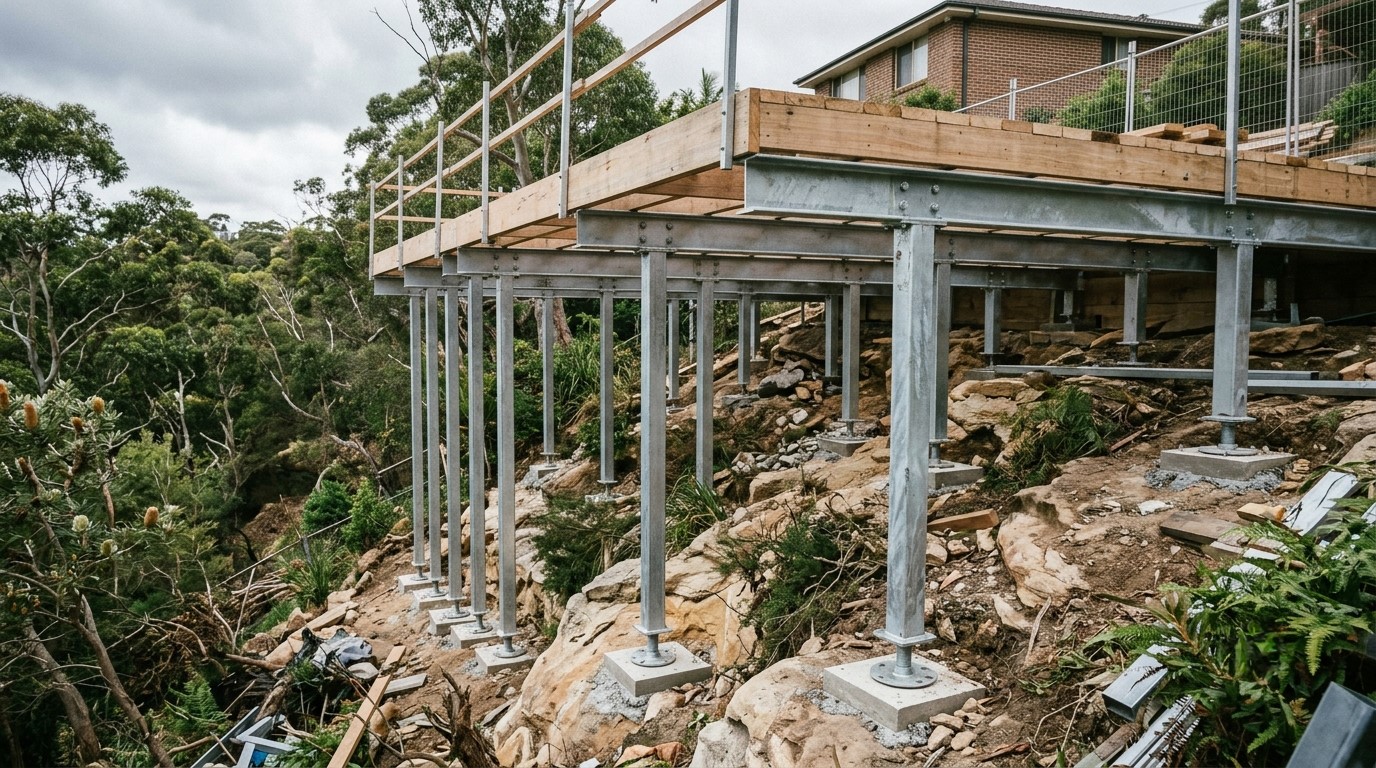
Take a recent job in Elanora Heights, on Sydney’s Northern Beaches. The block drops 1.8m over a 5m run straight off the back bi-fold doors, a genuinely steep 36 per cent grade running down into a heavily vegetated gully. Three things go wrong here with a timber subframe.
First, water runoff rot. On a slope, rain doesn’t soak in evenly, it runs straight downhill and pools around the lowest footings. Timber bearers and posts sitting near ground level in that kind of moisture start rotting within five to seven years.
Second, timber twist under tension. A high elevated deck needs long posts, and heavy 100x100mm or 90x90mm hardwood or treated pine posts naturally bow and twist as they dry out in Sydney’s heat. A 5mm twist at the base of a 1.8m post becomes a 20mm shift at the top. That’s what causes creaking, boards that run out of level, and a deck that bounces underfoot.
Third, the build itself is a safety problem. Hauling heavy 290x45mm F27 hardwood bearers up a muddy 36 per cent incline is genuinely dangerous, and it adds serious labour hours before a single board goes down.
How adjustable steel piers solve it
Instead of concrete encasing timber posts in deep holes and trying to notch each one to the right height on an incline, we use galvanised steel posts fitted with heavy duty threaded adjustable head plates, systems like Spantec’s Uni-Pier. A steel post base is concrete pinned to an engineered pier pad sunk into the rock or clay. A galvanised RHS steel post drops over the base, and a threaded steel top plate sits inside the top of the post. The steel bearer sits directly on that plate.
The advantage over timber posts on a slope comes down to three things. If the ground settles slightly in the first 12 months, you don’t pack up a sagging timber joint, you turn the threaded adjusting nut with a spanner and relevel the frame to laser accuracy in under a minute. The steel lifts the whole subframe clear of the soil and the water runoff path, so ground contact rot simply isn’t in play. And because structural steel like 150x50mm Boxspan can span up to 3.2m between piers, a steep block needs four to six piers rather than the ten to twelve holes a timber frame would force you to dig on a hazardous slope.
When you hit rock, not dirt
Sydney sandstone country, the Upper North Shore, Berowra, the Hawkesbury River slopes, brings its own problem: you often hit solid rock 200mm below the topsoil, which makes a standard 600mm deep pier hole impossible without a rock saw excavator and a bill running into the thousands.
Steel sidesteps the excavation altogether. Instead of digging deep, we core drill directly into the exposed sandstone bedrock, chemically anchor stainless steel threaded rods into it, and mount a low profile galvanised steel base plate straight to the rock shelf. The adjustable steel pier bolts on from there. The foundation ends up rock solid within a couple of hours, genuinely flood proof since there’s no timber to absorb moisture, and it avoids thousands of dollars in heavy machinery costs.
Cost and time, honestly compared
On a 35 square metre elevated entertainment deck over a 1.5m sloping block, the numbers actually favour steel once labour is counted, not just the material on the truck.
| Metric | Timber frame | Steel subframe |
|---|---|---|
| Footings required | 12 to 14 deep hand dug holes on a slope | 6 engineered rock or concrete pier pads |
| Framing build time | 3 to 4 days | 1.5 days |
| Subframe material cost | Approx. $3,200 | Approx. $4,100 |
| Subframe labour cost | Approx. $5,500 | Approx. $2,800 |
| Total installed cost | $8,700 | $6,900 |
The raw steel costs more off the truck, but it saves close to half the site labour and excavation cost on a steep hill. The final installed price ends up cheaper than timber, for a frame built to last around 60 years instead of the 15 to 20 you’d realistically get from timber on a slope like this.
A real result: Woronora
A block in Woronora, in the Sutherland Shire, dropped away toward the river. The homeowners wanted an outdoor living space and assumed the only way to get there was a multi thousand dollar retaining wall and earthworks package, just to create a flat ledge before a deck could even go on top. That quote came in at $28,000 before the deck itself was touched, and it would have permanently blocked garden access for an excavator.
We engineered an elevated steel cantilever deck instead. Heavy 150mm steel bearers anchored to the flat rock ledge near the house, cantilevered 1.2m out over the slope on long, slim steel Uni-Piers. The result was a seamless, rock solid 40 square metre deck floating over ground that was otherwise unusable, no retaining wall at all, over $18,000 saved on total site preparation, and the block’s natural drainage line left completely intact underneath.
If your block is flat and the question is really just DIY kit versus a proper build, that is a different comparison. Our guide to steel deck framing, kit versus custom breaks down the gauge, span and cost differences on level ground.
Getting the site right before you build
Every sloped block is different, some are mud and clay, some are sandstone shelf a foot under the topsoil, and the right footing solution depends entirely on what’s actually under the grass. Our sloping ground decking page covers the design side of building on a slope, and if your block is also in a bushfire zone, our bushfire zone decking guide is worth reading alongside it, since the two constraints often show up on the same site. Get in touch and we’ll walk your actual block before quoting either option.



